


On this page 6 sections
Your guide
What you'll learn
Many people in the fitness space utilize dumbbells for strength building, hypertrophy work, or functional fitness. It is not uncommon to see a huge rack with several (sometimes) neatly organized rows of them as soon as you walk into any gym. However, does your gym or fitness space have kettlebells? How many people do you see using them? Do you use kettlebells in your training, or does the sheer sight of them cause intimidation? In this article, we will look to remove that fear around the use of the kettlebell, and teach you how to harness its versatility for even more strength and functional movement gains with the best kettlebell exercises!
What is a kettlebell, and where does it come from?
Kettlebells are thought to have originated and popularized in the 1800s in Russia by a doctor named Vladislav Krayevsky. The term comes from the Persian word 'gerani', meaning difficult, and the Slavic word 'gur', which means bubble. Difficult bubble? We say 'no way! This weighted sphere with a handle evolved over time to be included in the world's most popular lifting and Highland competitions, and can still be seen today being utilized in feats of profound strength in the Strongman space. It is made of cast iron or steel, and is heaved, tossed, lifted, held, and swung in many competitions around the world today.
In most recent times, kettlebells have begun to pop up again in the gym and fitness space to train accessory power and explosiveness, functional fitness, and general health. They are portable and easy to throw into your trunk for a quick outdoor or hotel gym workout, and they come in many different sizes and weights! Kettlebell weights will usually be listed in kilograms (kg), but will most often times have the weight in pounds listed on the bell as well.
Who can benefit from using kettlebells?
We already know that kettlebells have a variety of different purposes for the athlete population, with the most common being the improvement of power and explosive muscular output. Check out this article (1) to see some applications of kettlebell training and tips on how to integrate them into a power program. This is especially beneficial for sports like soccer, Olympic weightlifting, and track and field sports that involve explosive throwing.
But what about the average person who just wants to improve their health and wellness? Or the person who is struggling with pain, poor balance, or other difficulty with moving their body? Yes, kettlebells are for you too! In fact, one study by Schafer et al (2) demonstrates how kettlebells are utilized to improve walking biomechanics and reduce falls in the amputee population. Another study by Moreno (3) shows kettlebell utilization to improve metabolic syndrome in women, and yet another by Jakobsen and colleagues (4) shows the benefits of kettlebell training to improve musculoskeletal pain in healthcare workers.
In short, kettlebells can be utilized by a variety of populations, whether you are an elite athlete or an average person just wanting to improve their health. This speaks to the versatility of the awesome kettlebell!
Learn How To Train For Longevity

I am a kettlebell beginner - what exercises should I do?
Never picked up a kettlebell before? Not to fear! Here are some simple introductory exercises with the kettlebell to get you started. Make sure to start with a LIGHT kettlebell - proper form is key to developing good movement patterns that promote injury prevention when using a kettlebell or other implement to exercise. Once your movement patterns are dialed in, you can slowly start to add weight to your exercises.
Exercise 01 of 06
Exercise demonstration
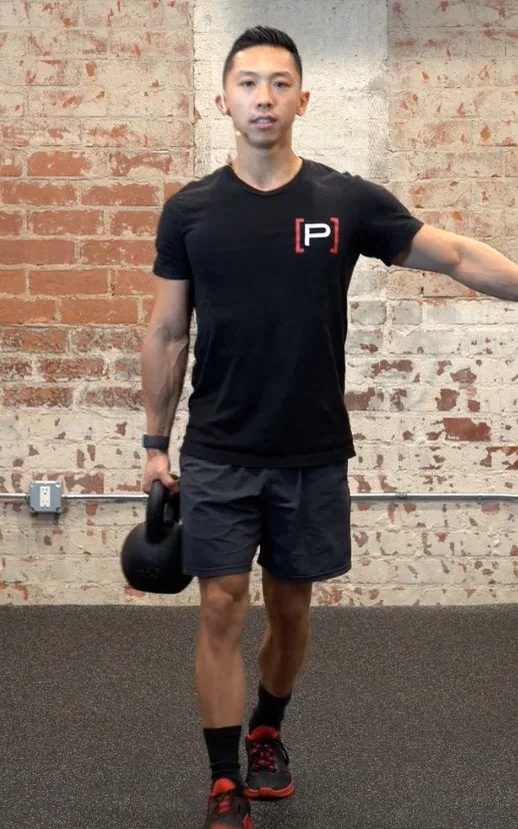
Unilateral Farmer Carry - Kettlebell
View exercise instructions
HOW: Grab onto a kettlebell with one hand in standing position. Hold the weight at the same height of the opposite shoulder. Use your core muscles to stay standing straight with appropriate core engagement.. Walk forwards and backwards for the prescribed amount while maintaining that even posture. Pretend like you have a cup of water on your head and you can’t spill it!
FEEL: You should feel your core and arm muscles working.
COMPENSATION: Don’t let the weight pull your shoulder down, maintain the same posture as the opposite shoulder. Stay balanced as you walk.
Exercise 02 of 06
Exercise demonstration
How To NOT Screw Up The Turkish Get Up | Episode 4
Exercise 03 of 06
Exercise demonstration
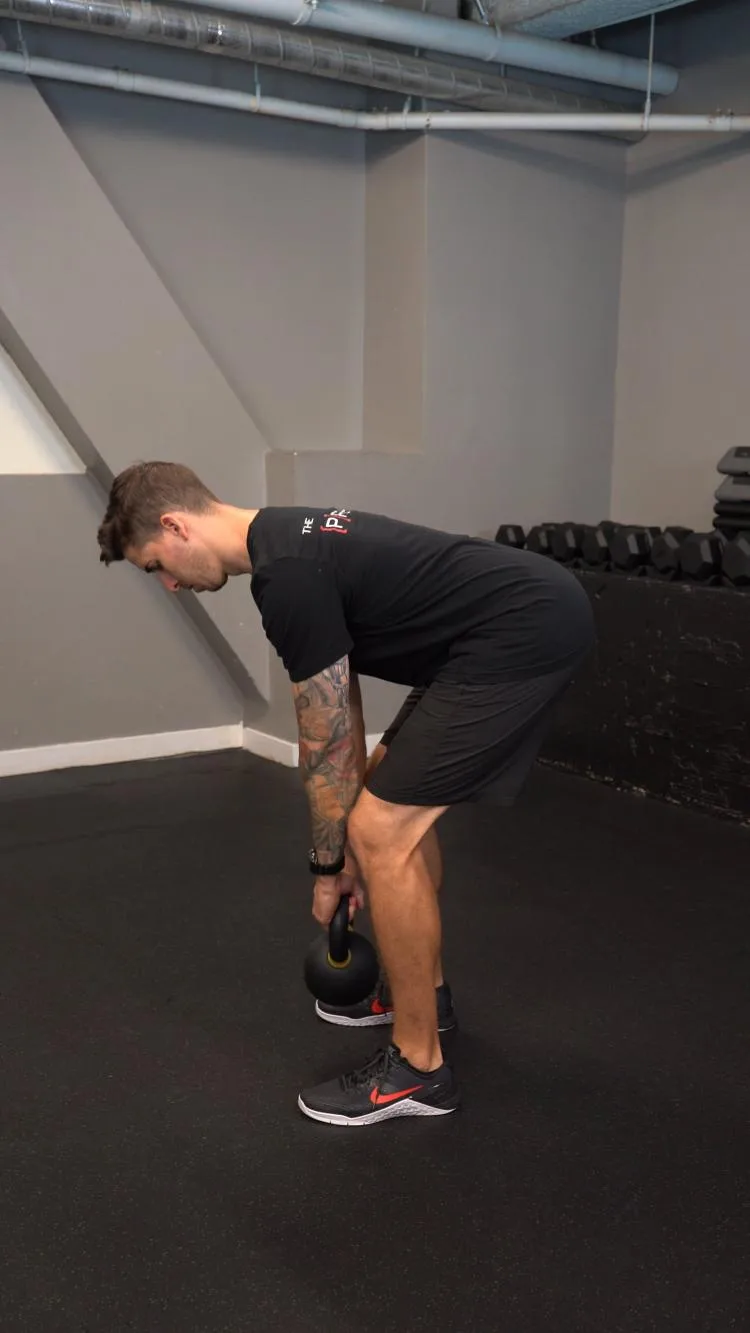
Deadlift - Kettlebell
View exercise instructions
- HOW: Set up a kettlebell in between your feet closer to your heels than your toes. Hip hinge and grab the KB with both hands. While keeping your back and neck straight, push the floor away using your legs and stand tall while keeping your shoulder blades squeezed back. Then hip hinge again and lower the weight down towards the ground and repeat. Ideally, the kettlebell should move in a straight line up and down.
- FEEL: Think about pulling the kettlebell handles apart by pulling your hands away from one another to help engage the muscles around your shoulder blades and your lats. Also, focus on keeping your core tight and do not let your lower back arch or bend especially as you lower the weight down and stand tall. This should primarily be a glute and hamstring workout.
- COMPENSATION: Do not bend or arch your low back, think about pushing the floor away to stand up versus using your upper body to stand up. Stay strong with your hands and upper body while holding the kettlebell tight.

I have some experience with kettlebells - how do I level up?
Once you are comfortable with some basic exercises, here are some more advanced kettlebell exercises to level up your gains!
Exercise 04 of 06
Exercise demonstration
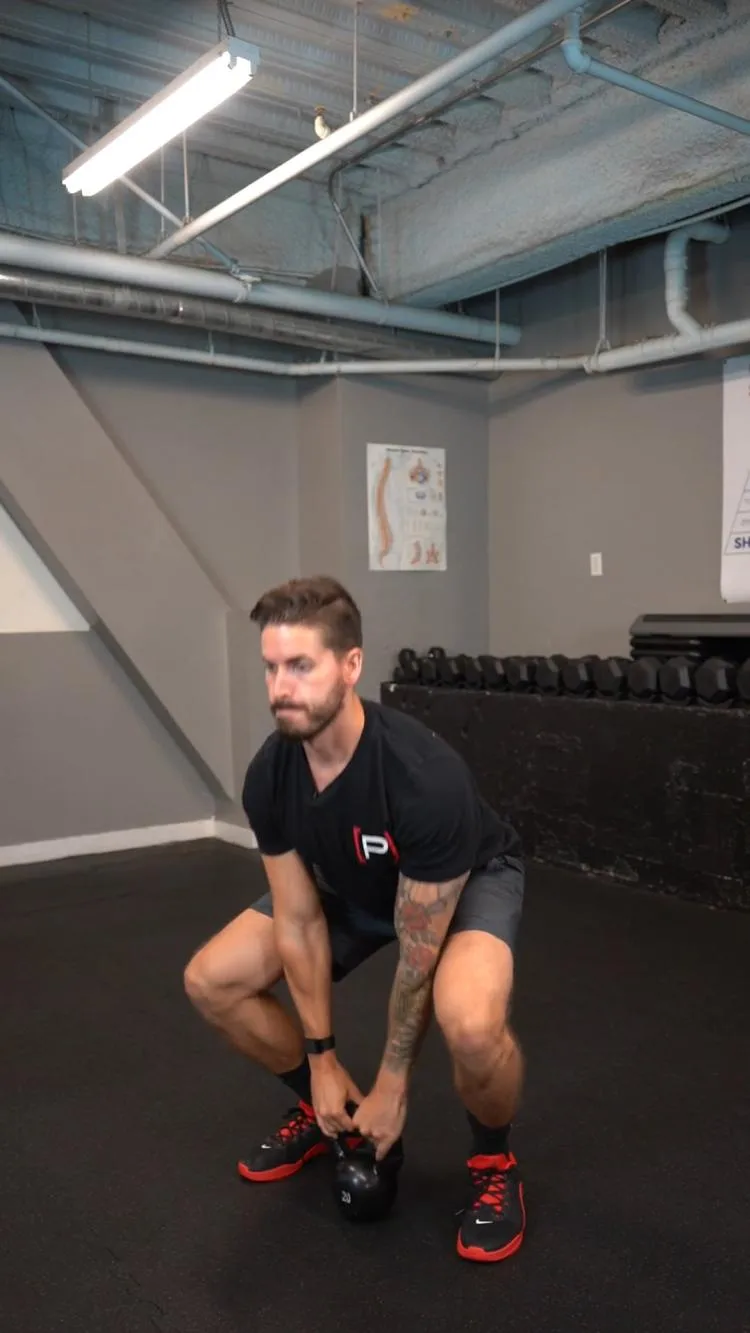
Clean To Overhead Press - Kettlebell
View exercise instructions
- HOW: Place a kettlebell on the ground in between your feet. Bend your knees, hinge forward at the hips, grab onto the kettlebell with both hands and pull your body into the ground. From here, push into the ground with your legs bringing your body up as you pull the kettlebell up in front of you driving your elbows up to the side. Then, drop your elbows down at your side switching your grip to catch the kettlebell as you squat down. Once you have squatted down, push into the ground and press the kettlebell overhead as you come up. Perform all of this in one fluid motion for the prescribed amount of reps
- FEEL: You should feel your lower body muscles working.
- COMPENSATION: Keep your back upright, don’t slouch.
Exercise 05 of 06
Exercise demonstration
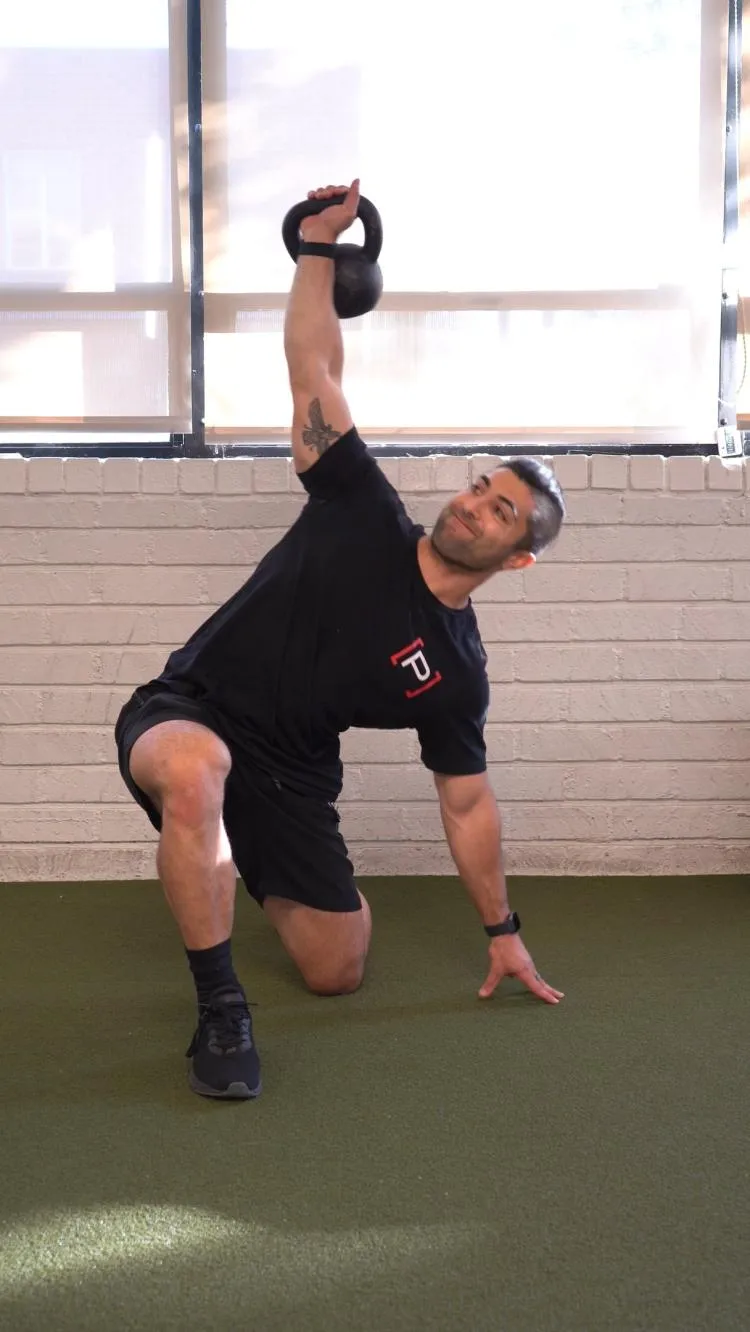
Half Kneeling Windmill - Kettlebell
View exercise instructions
- HOW: Begin in a half kneeling position with a kettlebell in an overhead position. With control lower yourself to the side that is free and tap the floor. At first you don't have to go all the way down, as you feel comfortable lower yourself as far as you can towards the floor.
- FEEL: The shoulder holding the kettlebell will be working throughout this exercise. The lower you reach towards the floor the more core activation you will get.
- COMPENSATION: Avoid bending the elbow on the arm holding the kettlebell, keep that arm locked out.
Exercise 06 of 06
Exercise demonstration
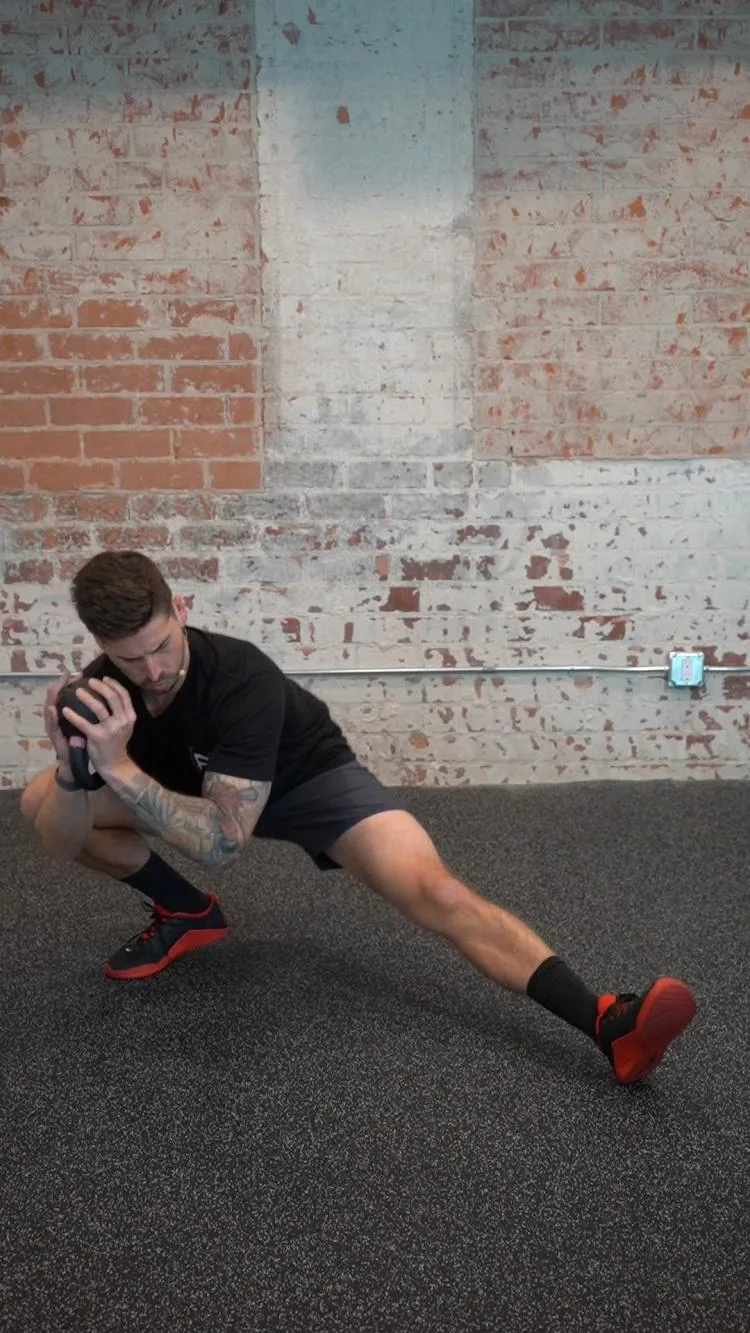
Cossack Squat
View exercise instructions
- HOW: Begin in a standing position with your legs as wide you can spread them. Grab onto a light weight with both hands and hold it in front of your chests with your elbows bent. From here, shift your weight to one side as you perform a deep lateral lunge. Use the weight you’re holding to try and sit back on your heel as you bend your knee as much as you can while the other leg stays straight and your foot rotates a bit upward. Alternate going into this deep squat on both sides.
- FEEL: You should feel your thigh and hip muscles working while squatting, and a stretch in your inner thigh muscles on the outstretched leg.
- COMPENSATION: Don’t round your back as you squat to one side, keep it upright.

Closing Thoughts
Whether you are an elite athlete or not, the kettlebell is a great training tool for putting strength, power, functional movement, and FUN into your fitness program! No matter what your goals are, the kettlebell can help you get there. We hope you enjoy these exercises to get you started!
Optimize Your Movement System and Train With Prehab!
References
- Harrison, Jeffrey S BSc, CSCS, NSCA-CPT1; Schoenfeld, Brad MSc, CSCS, NSCA-CPT2; Schoenfeld, Melody L CSCS3 Applications of Kettlebells in Exercise Program Design, Strength and Conditioning Journal: December 2011 - Volume 33 - Issue 6 - p 86-89doi: 10.1519/SSC.0b013e31822faf78
- Schafer ZA, Perry JL, Vanicek N. A personalised exercise programme for individuals with lower limb amputation reduces falls and improves gait biomechanics: A block randomised controlled trial. Gait Posture. 2018;63:282–9.
- Moreno KIP, P. A. Effects of kettlebell training on metabolic syndrome in women. Med Sci Sports Exerc. 2012;44:497-8.
- Jakobsen MD, Sundstrup E, Brandt M, Andersen LL. Effect of physical exercise on musculoskeletal pain in multiple body regions among healthcare workers: Secondary analysis of a cluster randomized controlled trial. Musculoskelet Sci Pract. 2018;34:89–96.
About The Author
Taryn Beaumont, PT, DPT, CLT, CF-L1, CNC
Prehab Writer& Content Creator
 Taryn was born and raised in Maine and still resides there with her boyfriend and son. Taryn received her Doctorate in Physical Therapy from Husson University in 2010, and also carries a Bachelor in Kinesiology and Human Movement Science. She is a Certified Lymphedema Therapist, a Certified Crossfit Level 1 Trainer, and a NASM Certified Nutrition Coach. Taryn has 10+ years of experience in many different realms of PT, from the young athlete to the geriatric patient. Taryn considers herself a ‘lifelong learner’. She has special interests in oncology care and breast health, dry needling, and Crossfit training. In her free time, Taryn enjoys fitness, spending time with her family, continuing education, writing, and reading, and is very excited to be a part of The Prehab team to educate and empower others to take control of their own health and wellness.