


On this page 8 sections
Your guide
What you'll learn
Picture this – it's 75 degrees outside. The sun is shining, the birds are chirping, and your body is ready for a workout. Who wants to take it down to the dusty old basement gym on such a perfect day?! Time to move that equipment outside and get after it! And, whether it's rain, snow, or shine, you can always find creative ways to stay active with these best outdoor exercises.
Benefits of Outdoor Workouts
A sad but true fact, 79.2% of Americans do not achieve the guidelines for aerobic conditioning and muscle strengthening. (1) Part of the reason for this may be that many people are uncomfortable with a traditional gym environment, or they don’t know where to start when it comes to navigating an overwhelming amount of gym equipment. Many people may feel self-conscious or fear of looking silly if it is their first time in a gym. The outdoor space provides a safer, more comfortable, and less intimidating option for folks who want to get (and stay) active, but experience barriers to a traditional gym setting as described above. Recent research shows that outdoor exercise increases participant adherence (2), enjoyment, and exercise satisfaction. (3)
So, if you are struggling to get to the gym or feeling bogged down, switch it up and TAKE IT OUTSIDE!
Looking For Guidance That Will Take You Through An Entire Fitness Program?

Tips for Taking It Outside!
Ready to step out that door and get after it? Here are some helpful tips to get you started:
- The outdoor space is a great one for aerobic work or doing a walk/jog/run. You can utilize parks, stadiums, walking trails or paths, hills, or neighborhoods to get your sweat on. Try switching it up every once in a while so you don’t get bored with the same scenery!
- Use what you’ve got! Look at your available outdoor workout spaces and think to yourself, “how can I use what is around me?” A column or light post makes a great place for a wall sit exercise, a railing offers a way to do pulling work, and a kids playground can easily become a pull up bar. Creating new movement experiences using the world around you can be really fun and memorable.
- Bodyweight exercise is your friend! Defined, bodyweight exercise is “a type of strength training where you use your own body weight to provide resistance against gravity.” (4) When you use your body weight for a workout, you are essentially using your body alone without any external exercise equipment such as dumbbells, kettlebells, or bands. Bodyweight training can be a very effective, ‘most bang for your buck’ tool for improving your health and fitness. Below we discuss several fun bodyweight exercises that are sure to make you sweat!

Exercise 01 of 05
Exercise demonstration
Burpee - Outdoors
View exercise instructions
- HOW: Start in a standing position. Begin the exercise by dropping down and performing a push up. Push yourself back up and get momentum to get into a squat position. Then perform a jump squat and repeat.
- FEEL: This should feel like a full body workout that will get your heart rate up. You will feel an upper body workout with the push up whereas a lower body workout with the squat jump.
- COMPENSATION: Watch the video for tips and tricks with hand placement and how not to bother your wrists, which can be common for some. All the same rules apply with your regular push up, jump squat, and landing mechanics form.
Exercise 02 of 05
Exercise demonstration
Drop Squats - Outdoors
View exercise instructions
- HOW: Start in a comfortable standing position with your hips and knees straight and extended. Very suddenly, drop into a squat position.
- FEEL: You will feel all the muscles in your legs working to control the landing and descent.
- COMPENSATION: Landing Position. Make sure your knees are aligned over your toes. They should not dive inwards on the landing. Your goal is to absorb as much of the landing forces as you can and land softly. That means that you want your hips and knees to bend as much as they can to absorb the force. If you do not let them bend much, you will land "stiff" and hard. Let your hips go back and your chest go down to help absorb the forces. Your toes should touch the ground first when you land and quickly your heels will follow. You should land in a "ready position" like you would if you were playing sports, with your weight ever so slightly forward on the balls of you feet. You should not fall forward or backwards after landing.
Exercise 03 of 05
Exercise demonstration
Jumping lunge
Master Your Home Workouts With This Tip | Episode 11
What Do I Need to Get Started with Best Outdoor Exercises?
Okay, so you are ready to start exercising in the nearby park or neighbor’s backyard – how do you get started? What factors are there to consider? We will outline them below!
WORKOUT STRUCTURE
There are many different ways to structure an outdoor workout. Many people utilize interval workouts to keep things fresh and interesting. Some of these examples include:
- Tabata-style intervals — 8 rounds of 20-second high-intensity intervals with 10-second recovery after each.
- Super sets — Exercises performed back to back with no rest. Options include reciprocal movements like pushing/pulling, alternating between lower/upper body, etc.
- Ladders — Multiple exercises performed in a row as a set with an increasing number of repetitions each set. For example, squats, push-ups, and lunges would be performed as a set that includes a sequence of 4-6-8-10 repetitions.
- Pyramids — Multiple exercises performed in a row as a set for an increasing then decreasing number of repetitions within each set. For example, squats, push-ups, and lunges performed as a set that includes a sequence of 5-10-15-10-5 repetitions.
EQUIPMENT
We discussed the effectiveness of bodyweight-style workouts, however, if you do have exercise equipment available, bring it outside with you! Medicine balls, dumbbells, kettlebells, resistance bands, and portable plyometric equipment can provide a creative way to provide variety as well as challenge the body in new and unique ways when exercising outdoors.
LISTEN: HOW TO CONTINUE TRAINING WHILE TRAVELING

We have provided a few exercises below that utilize resistance bands that would be perfect to do outdoors!
Exercise 04 of 05
Exercise demonstration
Single Leg RDL, Row - Outdoors
View exercise instructions
- HOW: Anchor a band to a lower position. Grab onto the band with one hand and shift your weight to one leg lifting the other leg off of the ground. From here, hinge forward at the hips kicking your leg back and letting your arm holding the band go towards the anchor. Then, simultaneously squeeze your glutes, pull the band band towards you engaging your shoulder blade muscles, and return to the starting position.
- FEEL: You should feel your glute, low back, and shoulder muscles working.
- COMPENSATION: Keep your back flat at all times.
Exercise 05 of 05
Exercise demonstration
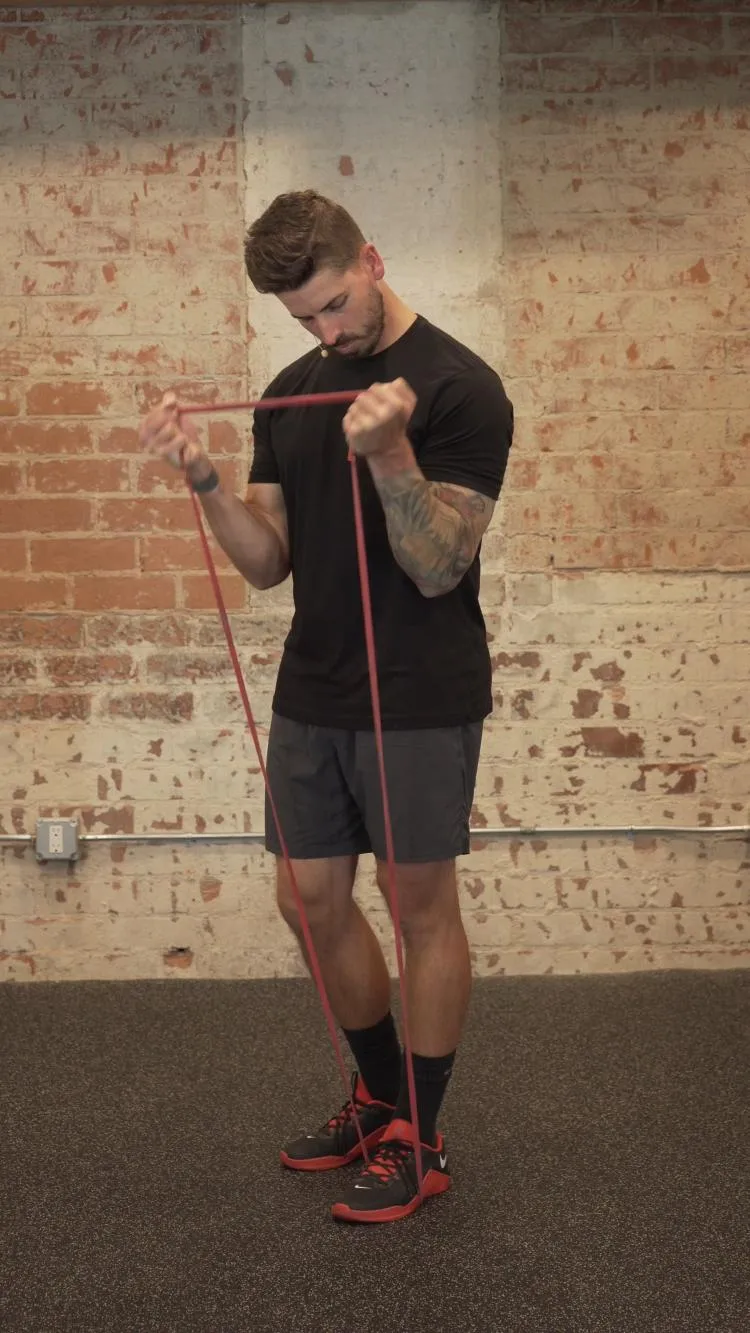
Bicep Curl - 3 Way, Band
View exercise instructions
- HOW: Loop a band underneath your feet and hold onto it with both hands in a standing position. The first curl, have your palms facing up with your elbows in while you curl the band up towards your shoulders. For the second curl, have your palms face each other. Then, the third curl have your palms facing down. Perform a full curl with each of these three for the prescribed amount of reps.
- FEEL: You will feel your biceps and forearm muscles working.
- COMPENSATION: Keep your shoulder blades back in a tall, upright position.
Putting It Together
Below we have provided an example from ASCM (5) that outlines a structured outdoor workout that can be done either with bodyweight alone or with resistance bands. Try utilizing the structure and throwing in your own exercises!

Closing Thoughts
Whether you are looking for a fresh change in your current workout routine or seeking out a way to start an exercise program that is fun and non-intimidating, look no further than the great outdoors! Grab your friends, kids, coworkers, or family members for some movement in the local park or community space. Remember, exercise is medicine, and being creative about your workouts can keep being healthy both engaging and enjoyable.
Learn How To Train For Longevity
REFERENCES
- CDC/NCHS. National Health Interview Survey, 2014. Sample Adult Core Component.
- Hug SM, Hartig T, Hansmann R, Seeland K, Hornung R. Restorative qualities of indoor and outdoor exercise settings as predictors of exercise frequency. Health Place. 2009;15(4):971–80.
- Thompson Coon J, Boddy K, Stein K, Whear R, Barton J, Depledge MH. Does participating in physical activity in outdoor natural environments have a greater effect on physical and mental wellbeing than physical activity indoors? A systematic review. Environ Sci Technol. 2011;45(5):1761–72.
- https://www.inmotionoc.com/benefits-of-bodyweight-exercises/#:~:text=Bodyweight%20exercises%20are%20a%20type,without%20any%20other%20exercise%20equipment.
- ACSM's Health & Fitness Journal21(1):10-15, January/February 2017.
- Stanford, Kathleen1; Pomeroy, Alexander1; Bates, Lauren C.1; Tamminga, Kyle2; Chai, Thevy2; Moore, Justin B.3; Brookey, Lindsay4; Stoner, Lee1 Exercise Is Medicine® on Campus during COVID-19: Necessary Adaptations and Continuing Importance, Translational Journal of the ACSM: Fall 2020 - Volume 5 - Issue 12 - e000157
- doi: 10.1249/TJX.0000000000000157
About The Author
Taryn Beumont, PT, DPT, CLT, CF-L1, CNC
Prehab Writer & Content Creator
 Taryn was born and raised in Maine and still resides there with her boyfriend and son. Taryn received her Doctorate in Physical Therapy from Husson University in 2010, and also carries a Bachelors in Kinesiology and Human Movement Science. She is a Certified Lymphedema Therapist, a Certified Crossfit Level 1 Trainer, and a NASM Certified Nutrition Coach. Taryn has 10+ years of experience in many different realms of PT, from the young athlete to the geriatric patient. Taryn considers herself a ‘lifelong learner’. She has special interests in oncology care and breast health, dry needling, and Crossfit training. In her free time, Taryn enjoys fitness, spending time with her family, continuing education, writing and reading, and is very excited to be a part of The Prehab team to educate and empower others to take control of their own health and wellness.