
On this page 5 sections
Your guide
What you'll learn
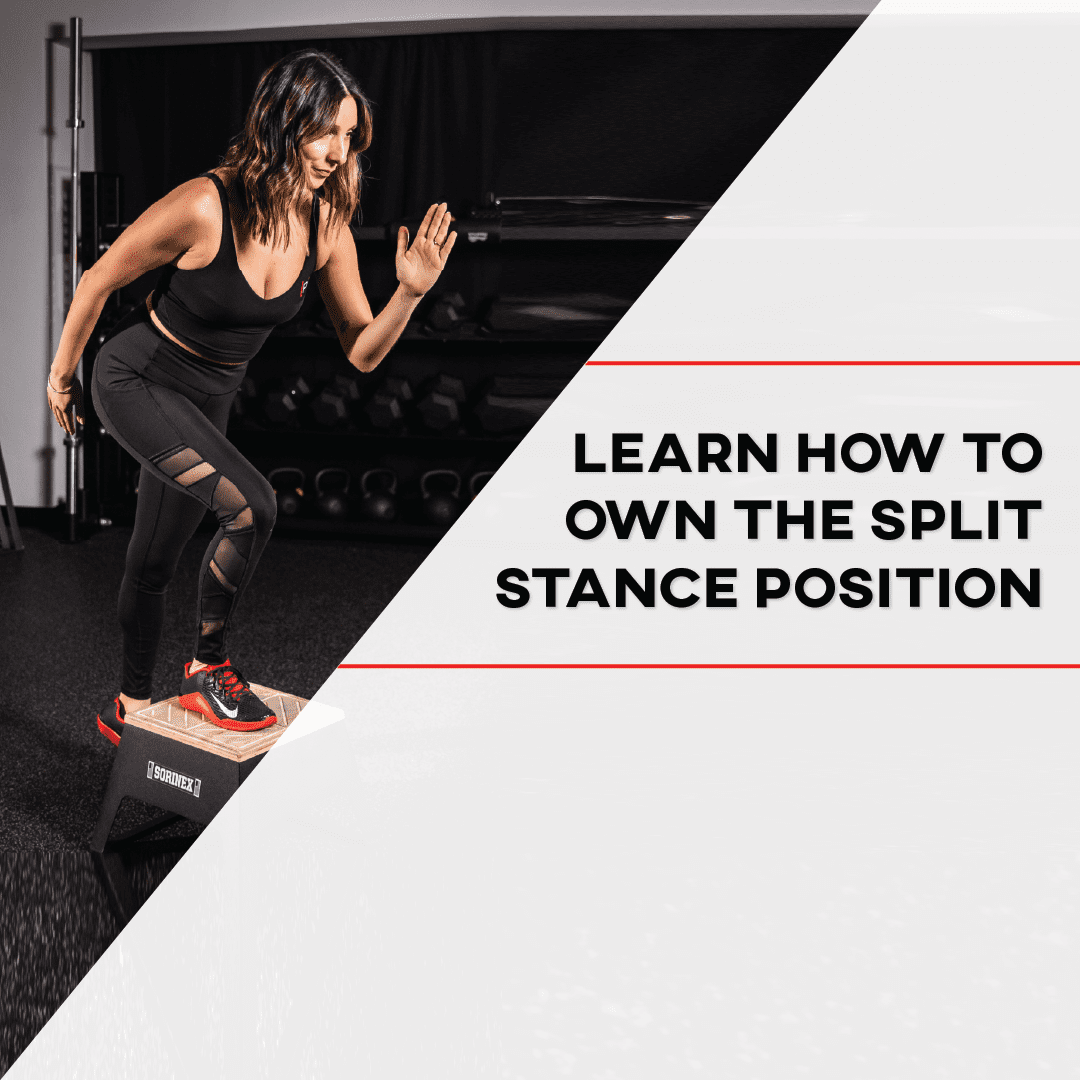
The split stance position is hands down one of the most underutilized positions when it comes to leg day workouts and lower extremity rehab. The split stance position can and should be utilized as a transitionary stance between the double leg and single leg positions. Double leg support positions like in the squat and deadlift are great for developing strength and power; however, they can hide asymmetries from side to side and don't truly test the body's ability to coordinate complex movement patterns. This is why single leg exercises are a staple in many strength and conditioning and rehabilitation programs alike. However, many people struggle with single leg exercises like single leg Romanian deadlifts, step downs, and single leg hopping due to a lack of coordination, balance, strength, or all of the above. This is where the split stance position shines and can be utilized to "bridge the gap" to single leg exercises. Learning to own the split stance position will elevate your gym games and [P]rehab your legs alike!
Split Stance Position Tutorial
This video is an absolute must-watch from beginning to end. Mike goes into stance distance and width, weight distribution, trunk positioning, common mistakes, and MORE!
Own Split Stances And Other Exercise Variations With Us!

Split Stance Foot Position
The first and most important thing to do when utilizing the splits stance position is to determine your foot positioning. Start by taking a slightly larger step than normal with one foot in front of the other. Now that you've found your stance, you next need to determine how wide apart to place your feet. The wider apart your feet, the easier it will be to balance. So if you find yourself constantly struggling to maintain balance, widen up your stance! Conversely, if you want to challenge your balance a bit more, choose a narrower stance.
Master The Different Lunge Variations
Weight Distribution in the Split Stance
Now that you've nailed down your foot position, the next thing to do is to choose how much weight to put through each of your feet. What's fantastic about the split stance position if you are in full control of how much weight to put through each of your feet. Under normal circumstances, you place the majority of your weight in your front leg, as that is the "working" leg. However, there are some exercise variations in which you are actually working the back leg. A good starting place for most is to put about 70% of their weight on the front leg and 30% on the back leg. Remember, in most exercises like the split stance lunge, you want the working leg to be the front leg!
LISTEN: LUNGE VARIATIONS WITH THE PREHAB GUYS

Now, where exactly in the foot to put that weight you ask? We can either put the weight forward in the balls of the foot (forefoot), in the middle (midfoot), or all the back in the heel (rearfoot). There is no wrong answer to where to shift your weight. However, you can selectively bias certain joints of structures based on where you put your weight. For example, by shifting the weight into the balls of the foot you force your knee and quadriceps muscles to work harder. Furthermore, it places more strain on your quadriceps, patellar, and Achilles tendon. This may be a fantastic option for someone with weak knees as it will strengthen the knees a ton! However, it may not be the best option for someone who is currently dealing with a bit of knee pain due to patellar tendonitis (jumper's knee) or patellofemoral pain syndrome. Conversely, by shifting weight onto the heel of the foot, you force your hips, glutes, and hamstrings to work a lot harder. This may be a fantastic temporary option for the person with knee pain described above to continue to exercise without placing too much load on their knees. If you don't care to selectively hit your knees or hips, stick with keeping the weight right in the middle!


Exercise 01 of 02
Exercise demonstration
Quad vs Glute Dominant Lunge
Changing your trunk position is also a very easy way to place more or less strain on your hips or knees.
- Leaning the trunk forward will make your glutes and hamstrings work harder
- Keeping the trunk upright will make your quadriceps work harder
Back Leg Split Stance Position
Exercise 02 of 02
Exercise demonstration
Split Stance Lunge - Rear Leg Emphasis

View exercise instructions
- HOW: Begin by stepping one foot forward and the other back with your toes pointed forward in a split stance position. Bend both knees and lower yourself down but shift over half of your bodyweight to the back leg. Push into the ground returning to the starting position. We are going to try to use our back leg as much as possible to return to the standing position!
- FEEL: You should feel your leg muscles working.
- COMPENSATION: Keep your chest upright. Make sure most of your bodyweight is on the back leg.
One of the secrets of the split stance position is you can actively work on stretching the back leg while simultaneously working out the front leg! Ultimately you want to get the most bang for your buck out of every exercise, so why work on stretching while strengthening? The split stance position can either be categorized as a high spilt or low split position. The difference between the two is really the back leg. In the high split stance position, the back leg is completely straight. Whereas in the low split stance position the back leg is bent. These positions are very similar to the half kneeling hip flexor stretch (rectus femoris bias) and the standing hip flexor stretch (iliopsoas bias).
Closing Thoughts
In conclusion, utilizing the split stance position in your training or rehab as a transition to true single leg exercises. Furthermore, it can also be utilized with heavier loads than what would normally be possible with single leg exercises.
Take Your Lower Body Performance To The Next Level
About The Author
Michael Lau, PT, DPT, CSCS
[P]rehab Co-Founder & Chief Product Officer
 Michael was born and raised in Northern California but now currently resides in Sunny SoCal ever since attending the University of California, Los Angeles as an undergraduate majoring in physiology. After his undergraduate studies, he received his Doctorate in Physical Therapy from cross-town rival the University of Southern California. As a licensed physical therapist with a strong background in strength and conditioning, Michael likes to blend the realms of strength training and rehabilitation to provide prehab, or preventative rehabilitation, to his patients. A common human behavior is to address problems after they become an issue and far often too late, which is a reactionary approach. He believes the key to improved health care is education and awareness. This proactive approach-prehab-can reduce the risk of injuries and pain in the first place. He is a huge proponent of movement education and pain science. Clinically, he has a special interest in ACLR rehab and return to sport for the lower extremity athlete.