

On this page 5 sections
Your guide
What you'll learn
You might feel nauseous, your feet might grow in size, you may feel very tired, you might experience urinary leakage, you could feel constipated, your back might begin to hurt, heartburn may creep up on you, oh and your core will naturally separate.
Sound familiar? If you’ve ever been pregnant or know someone who has been pregnant, these are very real and very normal symptoms that one can experience. The only problem? For a lot of individuals, these can feel very concerning and alarming! Let’s face it, pregnancy is an incredible gift, but also an incredible feat. Anyone who has been pregnant can attest to the physical challenges that it places on the human body. Let's dive into safe core exercises to do during pregnancy to help you tackle this incredible feat!
What is Diastasis Recti?
A large concern for many, and often misunderstood concern, is the natural core separation that occurs during pregnancy commonly known as diastasis recti. This can feel very intimidating throughout pregnancy, especially if an individual is experiencing pelvic pain, sacral pain, or low back pain. We know how valuable the core is in the management of pelvic and low back pain, so knowing that your core will separate during a life event that seemingly should require the most core strength can feel incredibly daunting.
So, what’s the good news? WE CAN SAFELY LOAD THE CORE DURING PREGNANCY! Even with naturally occurring diastasis recti? Yes, absolutely, and most definitely. Let’s dive into what diastasis recti is, why core strength training is valuable during pregnancy, and what safe core exercises to try during pregnancy.
Safe Postpartum Exercises to Do!

I’ll start by stating that diastsis is normal, natural, and needed during pregnancy! By definition, it is the separation of the core muscle (rectus abdominis) due to the stretching of the associated midline fascia (linea alba),that occurs as the baby grows within the uterus. It is typically measured in three locations including the belly button and just above and below it. Diastasis recti width can be measured with the use of fingers or calipers with ultrasound measurement being the most valid and reliable (2).

While this all sounds very clinical, the truth is that diastsis recti occurs naturally and should be celebrated as it is a sign that the baby is growing bigger and the human body is adapting appropriately. In fact, by the third trimester, diastasis recti has a prevalence of up to 100% and continues to be present well into the postpartum period (2). Studies have shown a prevalence of diastasis recti to be 60% at 6 weeks postpartum, 45% at 6 months postpartum, and 32% at 12 months postpartum (1). This is often very surprising to women as they may not feel limited by their diastsis recti during pregnancy or postpartum and want to continue or return to their prior level of exercise, but feel unsure of how to strength train with diastasis. If you are postpartum and curious where to start with exercise? Check out our YouTube video below!
The good news? You can strength train with diastasis recti during pregnancy. How cool is that?! Want to know more? Keep reading.
Strength Training with Diastasis Recti
Strength training with diastasis recti can feel very intimidating, especially when the core plays such a major role in stability with lifting. It used to be thought that direct loading of the core with diastasis recti during pregnancy could put more strain on the muscle. However, there is no research to support this theory and we now know that strengthening the core during pregnancy can assist in strength and recovery during postpartum (2).
LEARN MORE ABOUT OUR POSTPARTUM REHAB PROGRAM
Our 8-week Postpartum Rehab program is designed to improve your confidence in your pelvic floor, hips, core, low back, and provides you with the necessary education along the way! Please be sure that you have been cleared to begin activity by your OB-GYN prior to beginning our programming
It should first be mentioned that loading of the rectus abdominis muscle during pregnancy, and with diastasis recti, is permitted as long as it is done appropriately!
A study found that exercises targeting the rectus abdominis and oblique core muscles reduced diastasis recti to a greater extent than combined pelvic floor and deep core muscle exercises targeting the transverse abdominis (2).
This does not mean that pelvic floor exercises should not be a part of a strengthening program during pregnancy. There continues to be lots of research demonstrating pelvic floor muscle training to be the first treatment choice to prevent and reduce urinary incontinence both during pregnancy and postpartum. One study demonstrated that continent-pregnant women were 62% less likely to develop urinary incontinence later on in pregnancy and 29% less risk of incontinence during postpartum if they partake in pelvic floor muscle training (3). To learn more about the pelvic floor and physical therapy, check out our blog below!
READ: PELVIC FLOOR AND PHYSICAL THERAPY

Alright, let’s dive into some safe core exercises to do during pregnancy!
Exercises to Support Your Core During Pregnancy
As mentioned above, exercises that load the muscles of the rectus abdominis and oblique muscles have been shown to limit the separation at the linea alba to a greater extent than pelvic floor muscle exercises and deep core exercises targeting the transversus abdominis. As always, if you are pregnant or postpartum, we recommend connecting with a pelvic floor physical therapist who has experience working with this population and can instruct and supervise exercises that will work best for you! In the meantime, feel free to give these a try!
Exercise 01 of 03
Exercise demonstration
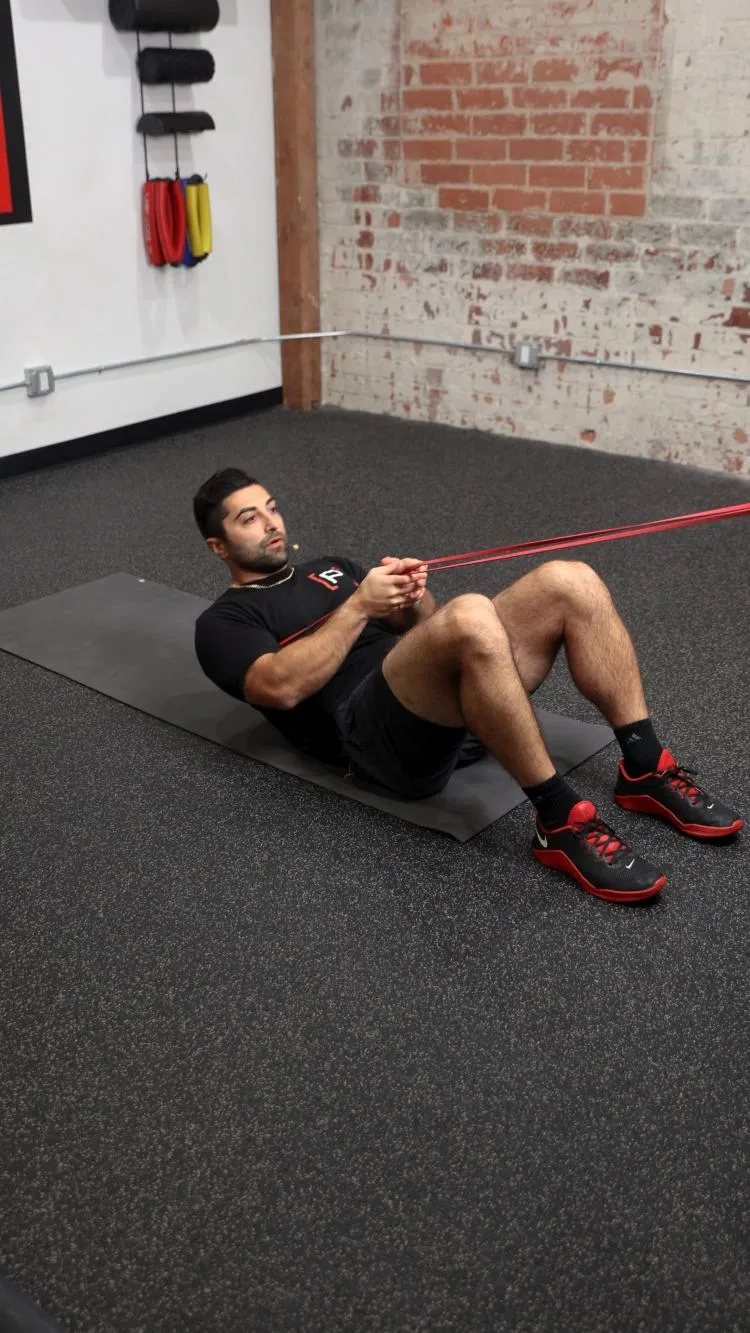
Sit Up - Assisted
View exercise instructions
- HOW: Begin this exercise laying on your back with your knees bent and with a resistance band anchored at shoulder height, wrap the band behind you. From laying on your back, use your core muscles and the band for assistance as you pull to a seated position. Return to laying on your back and perform for the suggested amount of repetitions or prescribed time.
- FEEL: You will feel your core muscles working as you perform this exercise.
- COMPENSATION: Avoid arching your back while performing this exercise, keep your core engaged from the beginning by performing a slight pelvic tilt by pulling your belly button down towards your spine.
Exercise 02 of 03
Exercise demonstration
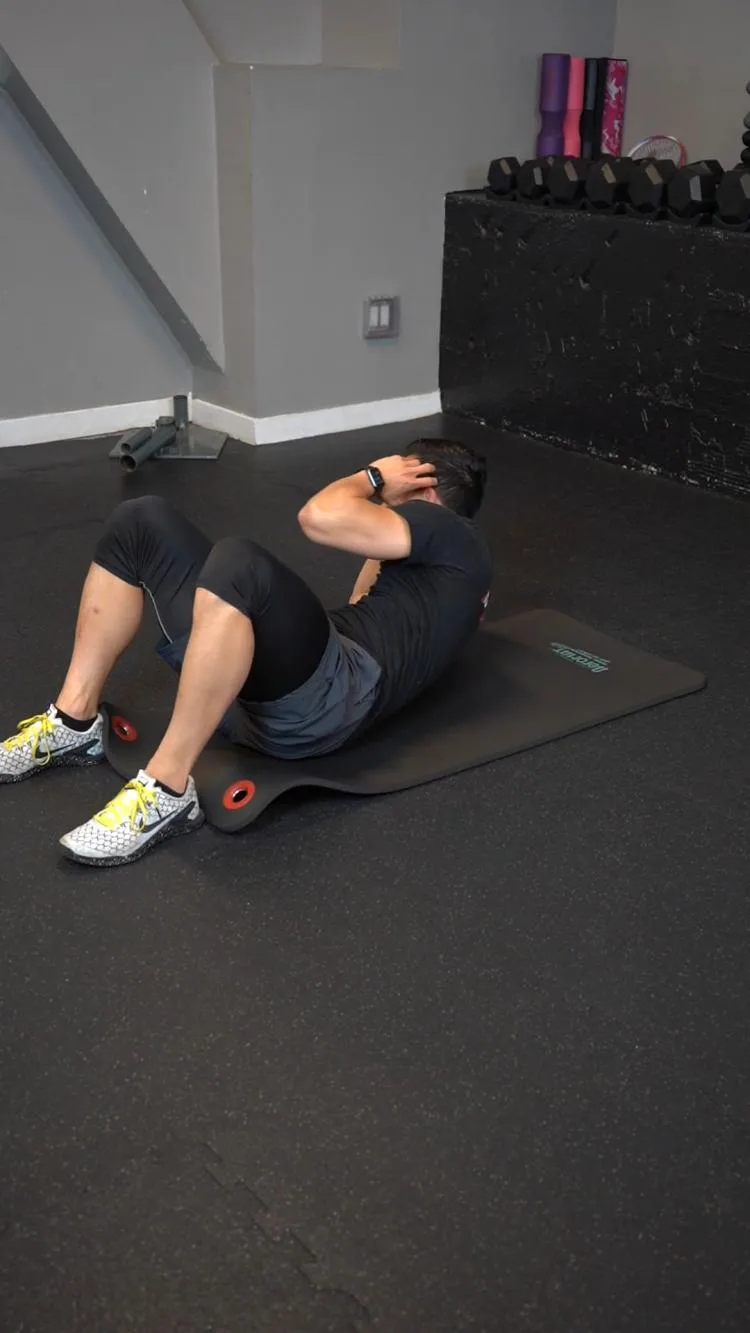
Oblique Crunch
View exercise instructions
- HOW: Start by lying on your back with your knees bent. Engage your core by drawing your ribcage down. Slowly bring your shoulders and upper back away from the floor. Your goal is to rotate and lift your left shoulder towards your right knee. Then lower yourself and repeat by lifting your right shoulder towards your left knee.
- FEEL: You should feel your core and abs working to lift your shoulders off the ground, especially the sides of your core in your obliques.
- COMPENSATION: Keep the movement slow and controlled.
Exercise 03 of 03
Exercise demonstration
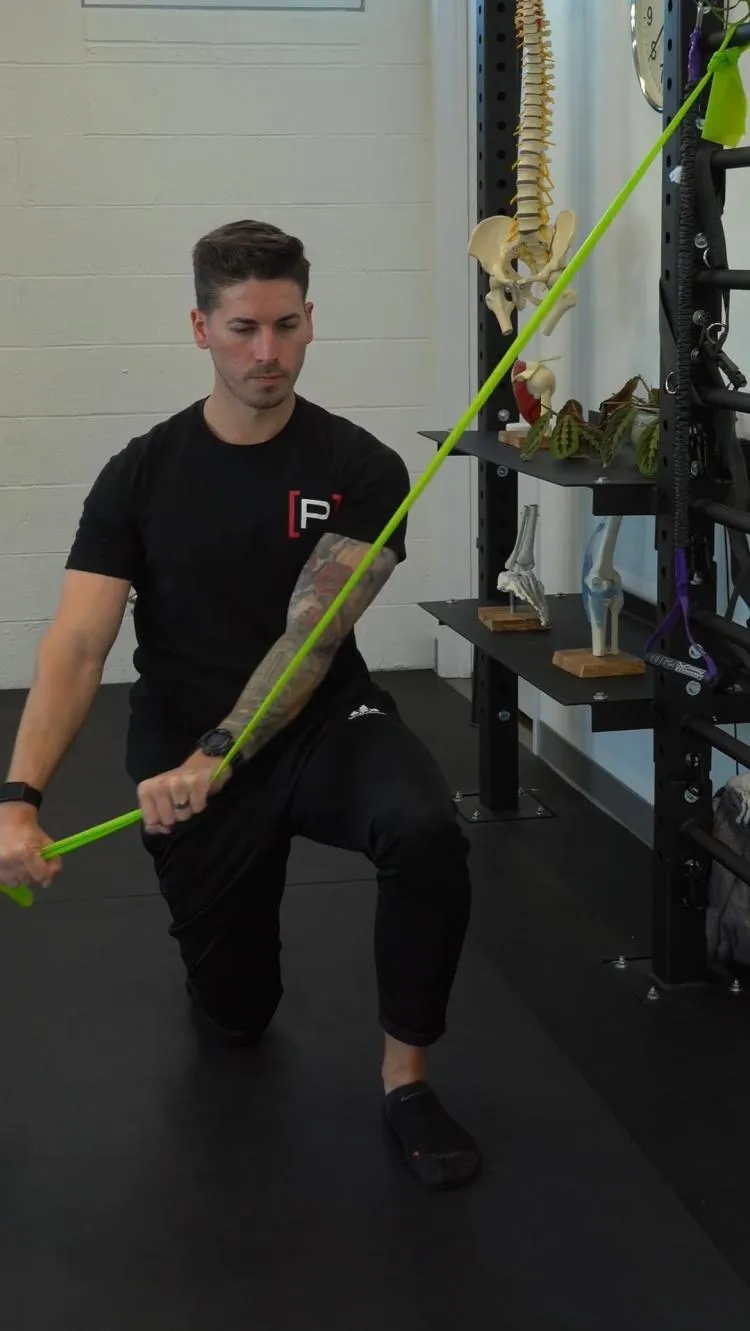
Half Kneeling Chop - Band
View exercise instructions
- HOW: Get set-up in a half kneeling position with a band anchored above your head to the side of you and the knee that is further away from the band anchor down on the ground. You can place something under your knee for comfort if desired. While holding onto the band with both palms facing down and keeping the rest of your body still, perform a chop motion diagonally downwards away from the anchor only moving your arms. Slowly return to starting position and repeat.
- FEEL: You should feel the muscles on the outside of your shoulders and shoulder blades working. You should also feel your core muscles and the hip muscles on the side that your knee is down working to help stabilize your body and torso.
- COMPENSATION: Do not lean forward or backward, do not tilt side to side, do not rotate your body.
Closing Thoughts
There are a lot of physical challenges that can feel limiting during pregnancy (friendly reminder to check in on your pregnant friends!) despite it also being a very beautiful journey. Nausea, fatigue, pelvic pain, heartburn, and a growing foot size…can all feel very daunting!
A large concern of many is often diastasis recti which is the separation of the rectus abdominis muscles throughout pregnancy and into the postpartum period. As mentioned, this process is natural and needed to make room for the growing baby in the uterus. However, many women feel limited in knowing how they can exercise safely and effectively with diastasis recti.
Public service announcement: You can safely perform core exercises with diastasis recti! Performing core exercises during pregnancy can be extremely beneficial to support both the pregnancy and postpartum period. If you are pregnant yourself or know someone who is pregnant, share the news! And remember, a strong core should never present as a physical challenge during pregnancy. You've got this!
LEARN MORE ABOUT OUR POSTPARTUM REHAB PROGRAM
Our 8-week Postpartum Rehab program is designed to improve your confidence in your pelvic floor, hips, core, low back, and provides you with the necessary education along the way! Please be sure that you have been cleared to begin activity by your OB-GYN prior to beginning our programming
References
- Sperstad JB, Tennfjord MK, Hilde G, Ellström-Engh M, Bø K. Diastasis recti abdominis during pregnancy and 12 months after childbirth: prevalence, risk factors and report of lumbopelvic pain. Br J Sports Med. 2016 Sep;50(17):1092-6. doi: 10.1136/bjsports-2016-096065. Epub 2016 Jun 20. PMID: 27324871; PMCID: PMC5013086.
- Theodorsen NM, Moe-Nilssen R, Bø K, Haukenes I. Effect of exercise on the inter-rectus distance in pregnant women with diastasis recti abdominis: an experimental longitudinal study. Physiotherapy. 2023 Dec;121:13-20. doi: 10.1016/j.physio.2023.08.001. Epub 2023 Aug 23. PMID: 37812848.
- Woodley SJ, Lawrenson P, Boyle R, Cody JD, Mørkved S, Kernohan A, Hay-Smith EJC. Pelvic floor muscle training for preventing and treating urinary and faecal incontinence in antenatal and postnatal women. Cochrane Database Syst Rev. 2020 May 6;5(5):CD007471. doi: 10.1002/14651858.CD007471.pub4. PMID: 32378735; PMCID: PMC7203602.
About The Author
Lyndsay Centrowitz, PT, DPT
Prehab Writer & Content Creator

Dr. Lyndsay Centrowitz graduated from Colorado State University with a BS in Health and Exercise Science and a concentration in Sports Medicine. After multiple personal sports-related injuries and discovering a passion for healing through movement, Lyndsay attended Creighton University to receive her Doctorate of Physical Therapy. An avid runner herself, she has a particular interest in working with high school, recreational, and elite endurance athletes and has undergone specialty training in pelvic floor rehabilitation, postpartum care, and management of the female athlete to better serve her clientele. Through this specialty training, she has acquired a Certificate of Achievement in Pelvic Health Physical Therapy through the American Physical Therapy Association. Lyndsay now owns her own practice StrongHER in Park City, UT where she specializes in female athletics and care of pregnant and postpartum individuals. Additionally, Lyndsay is BSPTS C2 certified in scoliosis specific exercises and has found a niche working with adolescents with scoliosis to improve overall spinal health. No, you’re not seeing double! Lyndsay is an identical twin to Lauren Lynass, one of our Prehab rockstars. A native of Colorado, Lyndsay is an adventure seeker who loves to hike, camp, and race her twin sister on the mountain trails. When she isn't exploring Park City's outdoor playground, you can find her curled up with a cup of tea and a good book. Follow along @strongher_dpt on Instagram!